all in one place.
| City | Country | Hits |
|---|---|---|
| Loading… | ||
| Time | City | View | Signed in | |
|---|---|---|---|---|
| Loading… | ||||
| Created | Last Sign-in | ||
|---|---|---|---|
| Loading… | |||
| # | Coin | Price | 24h % | Market Cap | Volume (24h) | |
|---|---|---|---|---|---|---|
| Loading market data… | ||||||
| Symbol | Name | Price | Change % | Day Range | ||
|---|---|---|---|---|---|---|
| Loading market data… | ||||||
| Symbol | Name | Price | Change % | Day Range | ||
|---|---|---|---|---|---|---|
| Loading market data… | ||||||
| Currency | Rate (per $1) |
|---|---|
| Loading forex rates… | |
The Core Idea
FIRE isn't one fixed plan — it's a target: build a portfolio large enough that its returns alone can cover your living expenses, indefinitely. Once you hit that number, work becomes optional. Some people stop entirely. Others keep working because they want to, not because they have to.
The two levers that matter most are your savings rate and your investment returns — and of the two, savings rate is the one you actually control day to day.
The 4% Rule
Most FIRE math starts with a simple heuristic: if you withdraw 4% of your portfolio in year one, then adjust that dollar amount for inflation each year after, a diversified portfolio has historically lasted 30+ years without running out. Flip that ratio around, and your FI number is roughly 25 times your annual expenses.
Flavors of FIRE
Lean FIRE
MinimalRetiring on a tight, minimal-expense budget — often under $40k/year. Requires the smallest portfolio but the least cushion for lifestyle creep or emergencies.
Fat FIRE
ComfortableRetiring with a much larger portfolio to support a higher, more comfortable spend rate — travel, dining out, no real budget anxiety. Takes longer to reach.
Barista FIRE
Hitting a partial number, then covering the remaining income gap with part-time or lower-stress work — often chosen for the benefits (like health insurance) as much as the paycheck.
Coast FIRE
Growth-OnlyHaving enough invested early that compound growth alone — with no further contributions — reaches your full number by traditional retirement age. You can downshift income sooner without needing to keep saving aggressively.
What It Doesn't Guarantee
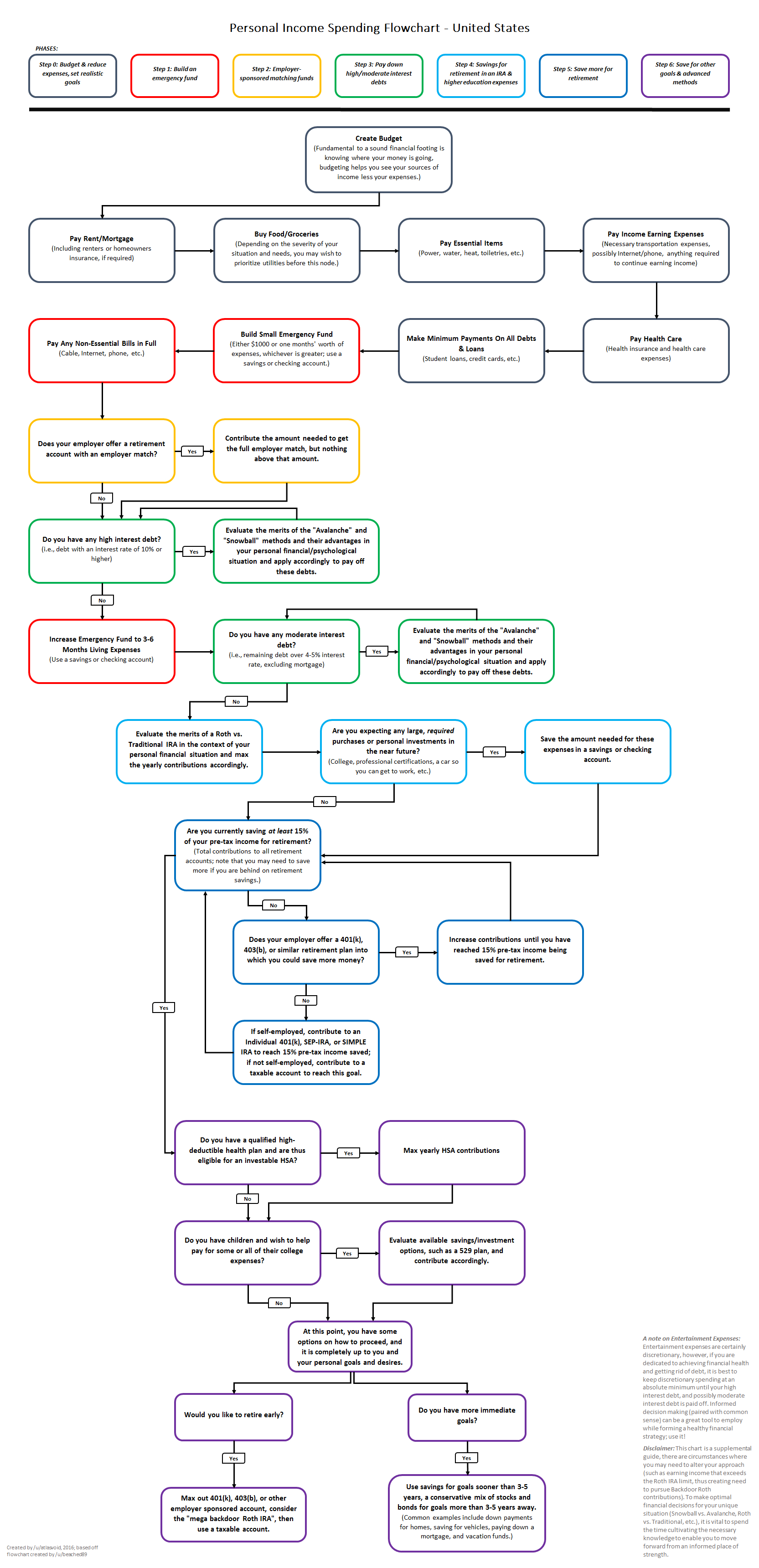
The Core Idea
A 401(k) is a retirement account offered through your employer. Money comes out of your paycheck automatically and goes into investments you choose — usually a mix of mutual funds or target-date funds. The trade-off for the tax break is reduced access: withdrawals before age 59½ generally trigger a 10% penalty on top of ordinary income tax, with a short list of exceptions.
Traditional vs. Roth 401(k)
Traditional 401(k)
Pre-taxContributions reduce your taxable income today. The money grows tax-deferred, and you pay ordinary income tax on withdrawals in retirement.
Roth 401(k)
After-taxContributions are made with money you've already paid tax on. Qualified withdrawals in retirement — including all the growth — are entirely tax-free.
Many plans let you split contributions between both. The right mix generally depends on whether you expect your tax rate to be higher or lower in retirement than it is today.
The Employer Match
Many employers match a portion of what you contribute — commonly something like 50¢ on the dollar up to 6% of salary. That match is effectively free money and an instant, guaranteed return that nothing else in a portfolio can match.
If your employer offers a match, contributing at least enough to capture all of it is usually worth doing before anything else — including extra payoff on low-interest debt.
Vesting
Your own contributions are always 100% yours. The employer match, though, may vest on a schedule — meaning you only keep it if you stay long enough. A common structure is graded vesting over 3–5 years, or a "cliff" where you keep 0% before a date and 100% after. Check your plan's summary before assuming a match balance is fully yours.
Salary-Multiple Benchmarks
One widely cited benchmark (popularized by Fidelity) frames retirement savings as a multiple of your current salary at each age, assuming saving starts around 25, retirement around 67, and a fairly typical mix of stocks and bonds along the way.
| Age | Target (× Salary) | Example at $75,000 Salary |
|---|---|---|
| 30 | 1× | $75,000 |
| 35 | 2× | $150,000 |
| 40 | 3× | $225,000 |
| 45 | 4× | $300,000 |
| 50 | 6× | $450,000 |
| 55 | 7× | $525,000 |
| 60 | 8× | $600,000 |
| 67 | 10× | $750,000 |
Why This Is a Rough Guide, Not a Target
A More Personal Number
The FIRE section's 4% rule gives a more direct way to size a target: roughly 25 times your actual annual expenses, not your salary. That number is grounded in what you'll actually spend, which matters far more than what you happen to earn.
What Makes a Roth IRA Different
You contribute money you've already paid income tax on. In exchange, all future growth — decades of it, potentially — comes out completely tax-free in retirement, as long as the withdrawal is qualified (generally: the account is at least 5 years old and you're 59½ or older). Unlike a traditional IRA, the original owner never has to take required minimum distributions (RMDs).
2026 Income Limits
Roth IRA eligibility phases out at higher incomes, based on Modified Adjusted Gross Income (MAGI). Above the top of the range, you can't contribute directly at all.
The Backdoor Roth
If your income is above the direct-contribution limit, the "backdoor" is a two-step workaround that's legal and widely used: contribute to a non-deductible traditional IRA (no income limit on that), then convert it to a Roth IRA shortly after. Since the contribution was already taxed, little or nothing is typically owed on the conversion itself.
The Pro-Rata Rule Catch
401(k) — 2026
That puts the effective cap at $32,500/year for ages 50–59 and 64+, and $35,750/year for the 60–63 "super catch-up" window created by SECURE 2.0. These limits apply to your own contributions — traditional and Roth 401(k) combined — not the employer match, which has its own separate, higher total-contribution ceiling.
IRA (Traditional + Roth combined) — 2026
This limit is shared across all your IRAs combined — you can split it between a traditional and Roth IRA, but the total across both can't exceed it.
Year Over Year
| Limit | 2025 | 2026 |
|---|---|---|
| 401(k) employee deferral | $23,500 | $24,500 |
| 401(k) catch-up (50+) | $7,500 | $8,000 |
| 401(k) catch-up (60–63) | $11,250 | $11,250 |
| IRA contribution | $7,000 | $7,500 |
| IRA catch-up (50+) | $1,000 | $1,100 |
The Core Idea
A budget is a plan that matches your expected income to your expected spending over a period — usually a month — so you decide where dollars go instead of discovering it after the fact. It isn't a punishment or a spreadsheet flex; it's a tool for making sure the money that matters most (rent, debt, savings) gets covered before the money that matters least (impulse buys) eats into it.
Without one, you're still budgeting — you're just doing it retroactively, by checking your balance and hoping.
What a Budget Actually Tracks
Why Budgets Fail
Too restrictive
Cutting every non-essential expense to zero rarely lasts. Budgets that leave no room for fun tend to get abandoned within weeks.
Not automated
LeakyManual tracking that depends on remembering to log every purchase decays fast. Automating transfers to savings and bills removes the willpower requirement.
No buffer category
A budget with no slack breaks the first time a $40 surprise expense shows up — which then feels like failure instead of normal variance.
Set and forget
StaleCosts drift — subscriptions creep, rent rises. A budget nobody revisits stops matching reality within a few months.
Budgeting Isn't About Restriction
The goal isn't to spend as little as possible — it's to spend on purpose. A well-built budget can include eating out, streaming subscriptions, and hobbies; it just makes sure those are choices you made, not defaults you fell into.
The four methods covered in Budgeting Methods Compared differ mainly in how much structure they impose — pick the one that matches how much detail you actually want to track.
The 50/30/20 Rule
Splits after-tax income into three buckets: 50% needs, 30% wants, 20% savings and debt payoff. Popularized by Sen. Elizabeth Warren's book "All Your Worth," it's the lowest-effort method since it only requires three numbers, not a full category-by-category plan.
Low effortZero-Based Budgeting
Every dollar of income gets assigned to a category — bills, groceries, savings, fun — until income minus allocated spending equals zero. Nothing is "unbudgeted." It's more work to set up than 50/30/20 but gives the most granular control, and it's the method behind the Zero-Based Builder tool.
The Envelope System
Cash — physical or digital — is divided into spending categories up front; once an envelope is empty, spending in that category stops until next period. Originally literal envelopes of cash, now often recreated with separate bank sub-accounts or budgeting apps. Its rigidity is the point: it makes overspending physically impossible instead of just discouraged.
Medium effortPay-Yourself-First
Savings and debt payoff are treated as the first "bill" paid each month, before any other spending — typically via an automatic transfer on payday. Everything left over is available to spend freely. It flips the usual order (spend, then save what's left) and tends to work well for people who find detailed category tracking tedious.
Low effortSide by Side
| Method | Setup Effort | Best For | Flexibility |
|---|---|---|---|
| 50/30/20 | Low | Beginners, simple finances | High |
| Zero-Based | High | Detail-oriented planners | Low |
| Envelope | Medium | Overspenders, cash-based | Low |
| Pay-Yourself-First | Low | Automators, inconsistent trackers | High |
Which One Should You Use
There's no universally "best" method — the right one is whichever you'll actually keep using. Start with 50/30/20 or pay-yourself-first if you want something simple and automatic; move to zero-based or envelopes if you've tried the simpler methods and money still disappears without a clear reason.
Methods aren't mutually exclusive either — many people pay themselves first for savings, then use rough 50/30/20 percentages for the rest.
Fixed Expenses
Costs that stay the same amount each period and are typically contractual — rent or mortgage, car payments, insurance premiums, subscriptions, loan payments. Because they don't change month to month, they're the easiest to budget for exactly, but also the hardest to reduce quickly — cutting a fixed cost usually means renegotiating a contract or making a bigger life change (moving, refinancing, canceling a plan).
Variable Expenses
Necessary spending that fluctuates in amount month to month — groceries, utilities, gas, phone data overages, medical copays. You can't eliminate these, but you can influence the size: a cold month raises the heating bill, a grocery trip with sales prices lower than one without. Variable expenses are where a budget needs the most padding, since the exact number is a forecast, not a fact.
Discretionary Expenses
Spending that's optional entirely — dining out, entertainment, hobbies, travel, upgrades you don't need. This is the category with the most control and the first place to cut when a budget runs over, but it's also worth protecting some room in, since a plan with zero discretionary spending rarely survives contact with real life.
At a Glance
Fixed
ContractualRent/mortgage, car payment, insurance, gym membership, subscriptions.
Variable
Groceries, utilities, gas, medical costs.
Discretionary
OptionalDining out, entertainment, travel, hobbies.
Why the Distinction Matters
When a budget needs to shrink — income drops, an emergency hits — the order of cuts should generally go discretionary first, then variable (find cheaper substitutes), and fixed expenses last, since those often require weeks of notice or a contract change to adjust. Knowing which bucket an expense sits in ahead of time turns "I need to cut $300" into a clear, ordered list instead of a scramble.
Quick Reference
| Category | Type | Typical Example |
|---|---|---|
| Housing | Fixed | Rent / mortgage payment |
| Insurance | Fixed | Auto, health, renters/home |
| Groceries | Variable | Weekly food shopping |
| Utilities | Variable | Electric, gas, water |
| Dining Out | Discretionary | Restaurants, coffee, takeout |
| Entertainment | Discretionary | Streaming, concerts, hobbies |
The Core Problem
Standard budgeting assumes a predictable paycheck. Irregular income — freelancing, commission, seasonal work, gig platforms — breaks that assumption, so applying a fixed-income budget on top of variable income just produces a plan that's wrong every single month, in one direction or the other.
Budget Off Your Lowest Realistic Month
Instead of budgeting off an average, budget fixed and variable expenses against the lowest income month from roughly the past 6–12 months. If that number still covers essentials, every month at or above it is safe by construction; anything earned above that floor becomes extra income to allocate, not income you were counting on to pay rent.
Pay Yourself a Salary
A common technique: route all income into a separate account, then transfer a fixed, modest "paycheck" from that account to your everyday spending account on a set schedule — the same amount every time, regardless of what came in that particular week. The gap between actual income and the salary you pay yourself becomes a buffer that smooths out slow periods.
Build the Buffer Before Anything Else
Before fine-tuning categories, the highest-leverage move for irregular income is building 1–3 months of expenses in a separate buffer account. That buffer is what makes "pay yourself a salary" possible — without it, a slow month forces spending cuts immediately instead of drawing down savings smoothly.
Taxes: The Quiet Gotcha
Irregular income doesn't mean budgeting is impossible — it means the budget has to be built around a floor and a buffer instead of a fixed number, with taxes set aside as they're earned rather than scrambled for later.
What Is It
A score from 300–850 that summarizes how likely you are to pay back money you borrow. It's calculated from your credit reports — files kept by three bureaus (Equifax, Experian, TransUnion) that track your borrowing and repayment history. You don't have one score; you have dozens, generated by different models (mostly FICO and VantageScore) — most lenders use FICO.
The 5 Ingredients
Rule of thumb: payment history + utilization = 65% of your score. Master those two and the rest takes care of itself.
Score Ranges (FICO)
| Range | Rating |
|---|---|
| 800–850 | Exceptional |
| 740–799 | Very Good |
| 670–739 | Good |
| 580–669 | Fair |
| 300–579 | Poor |
Building Credit From Scratch
→ Get a secured card (you put down a deposit as your limit), or become an authorized user on someone else's card.
→ Use it lightly, and pay it off in full every month.
→ Keep the account open — length of history matters, so don't close your first card once you upgrade.
→ Some services now let rent and utility payments count toward your score too.
Checking It
Free reports: AnnualCreditReport.com gives one report from each bureau — stagger the three across the year for free year-round visibility.
Free scores: many banks and card issuers show your score for free. Checking your own score is a "soft" check — it never hurts your score.
Check periodically for errors or signs of fraud, not just before a big application.
Mortgage Rate Tiers
Lenders price mortgages in roughly 20-point tiers, with the biggest jumps in rate and eligibility happening at a few key thresholds.
| Score | What Changes |
|---|---|
| 500 | FHA loan floor (10% down) |
| 580 | FHA loan with just 3.5% down |
| 620 | Conventional loan floor |
| 640 | USDA loan floor |
| 680–720 | Rate / PMI pricing improves noticeably |
| 740+ | Best conventional rates typically unlock |
| 760+ | "Excellent" tier — broadest options, lowest PMI |
Gold rows = the biggest threshold jumps.
Lenders typically use your middle score across the three bureaus, or the lower of the two middle scores if you're applying with a co-borrower. On a ~$378K loan, the difference between the best and worst score tiers can mean roughly $168/month and $60,000+ in total interest over 30 years — though the practical gap between a 780 and a "perfect" 850 is negligible, so there's little reason to chase a perfect score once you're past ~760–780.
Other Use Cases
Auto loans
Wider spread than mortgages — a subprime borrower can pay double-digit APR while a top-tier borrower gets near-zero promotional financing.
Credit cards
Determines both approval odds and what's offered: secured/subprime cards below 670, standard rewards 670–739, premium travel/cashback 740+, invite-only above 800.
Renting an apartment
Many landlords pull a credit report as part of the application, independent of income — late payments and high debt can be a red flag even if you can afford the rent.
Insurance premiums
Most states allow a credit-based insurance score to affect auto/home rates. A handful of states — California, Massachusetts, Hawaii — ban the practice entirely.
Utilities & cell plans
Thin or poor credit can trigger a required security deposit to open the account; good credit usually waives it.
Employment
Some employers — mainly for cash-handling, finance, or security-clearance roles — pull your report (not your score) as part of a background check, with your written consent.
Soft vs. Hard Inquiries
Soft inquiry
No impactChecking your own score, pre-approval offers, employer checks. Never visible to lenders.
Hard inquiry
Actually applying for a card, loan, or mortgage. A small, temporary dip — usually a few points — visible to lenders for about 2 years.
Rate-shopping tip: multiple hard pulls for the same loan type within 14–45 days (depending on the model) are usually counted as one inquiry — so it's safe to shop around for a mortgage or auto loan.
| Company | Date | Exchange | Price | Shares Out. | Valuation |
|---|---|---|---|---|---|
| Loading IPO calendar… | |||||